OSHA 10 vs. OSHA 30: Which Course Does Your Team Need?
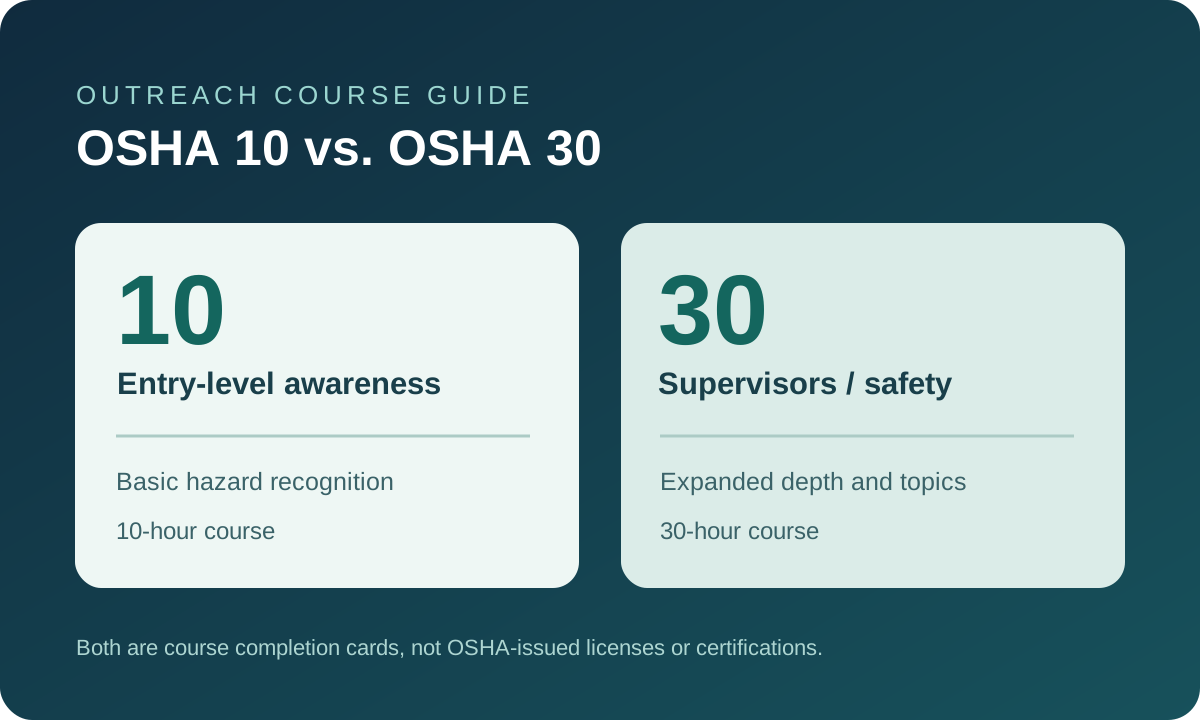
OSHA 10 and OSHA 30 are two levels of Outreach safety-awareness training. The 10-hour course is designed mainly for entry-level workers; the 30-hour course goes deeper and is intended for supervisors or workers with safety responsibilities. Neither course is a federal OSHA certification, and neither replaces job-specific training under an applicable safety standard.
What to remember
- OSHA 10 is primarily for entry-level workers learning basic hazard awareness.
- OSHA 30 offers more depth and topics for supervisors and workers with safety responsibilities.
- Neither is an OSHA certification, and federal OSHA does not require Outreach courses generally.
- State, municipality, owner, union and site-specific rules may specify which course a worker needs.
OSHA 10 vs. OSHA 30 at a glance
Course comparison based on OSHA's program description
| Question | OSHA 10 | OSHA 30 |
|---|---|---|
| Intended audience | Primarily entry-level workers | Supervisors and workers with safety responsibility |
| Course length | 10 hours | 30 hours |
| Coverage | Basic awareness of workplace hazards and rights | Broader range and greater depth of hazard-awareness topics |
| Is it federal OSHA certification? | No | No |
| Does the student card expire federally? | No | No |
| Replaces OSHA standard-specific training? | No | No |
The right course also depends on the industry. OSHA Outreach programs are divided into areas such as Construction and General Industry; a project specifying Construction 30 should not be treated as satisfied merely by a General Industry 30 course without checking its terms.
Who should take OSHA 10?
OSHA describes the 10-hour program as primarily for entry-level workers. It introduces hazard recognition and avoidance, worker rights and employer responsibilities. For a small construction contractor, that may describe new craft workers who need a common safety-awareness baseline.
An employer might decide that a worker with prior experience still benefits from an OSHA 10 course. But do not assume every role must complete it: check applicable state, locality, project and employer requirements before making it mandatory.
Who should take OSHA 30?
OSHA's 30-hour program is intended to give supervisors and people with safety responsibilities a wider and deeper set of topics. It can be appropriate for forepersons, crew leaders, field supervisors or managers whose work includes recognizing, discussing and coordinating hazard controls.
Having an OSHA 30 card does not automatically make someone a legally designated competent person for every task. Specific responsibilities and employer designation require meeting the relevant standard, not just holding an Outreach card.
When is OSHA 10 or 30 required?
The federal OSHA Outreach program is voluntary. Some states, municipalities, contract owners, unions or employers require a particular Outreach course for specific jobs. A contract may call for Construction 10 for craft workers and Construction 30 for supervisors, but that is a project-specific example—not a national mandate.
Before paying for courses, check the job location, trade, owner contract, role and accepted program. Document the actual rule, source URL or contract reference, rather than keeping an unexplained 'OSHA required' column.
Questions for a project manager or safety lead
- Which industry program is accepted: Construction, General Industry or another?
- Does the requirement apply to all workers or only supervisory roles?
- Does a local rule impose a recency condition or approved provider list?
- What proof will the site accept at check-in?
- What task-specific employer training is still required?
What about expiration and refresher training?
OSHA's current Outreach FAQ states student course completion cards do not have expiration dates. However, employers or project rules may require a more recent course. Keep the date of course completion and any site-specific recency rule separately, instead of assigning a guessed federal expiration date.
See Does OSHA 10 Expire? for the federal rule, replacement-card limits and how to record employer policies accurately.
How to manage both courses across a growing crew
- 1Define accepted programs for roles
Create separate entries for OSHA 10 Construction, OSHA 30 Construction and other accepted variants.
- 2Capture verified proof
Record employee name, actual course completion date, program and source of the card.
- 3Map job-site restrictions
Keep contract-specific course requirements separate from federal card validity.
- 4Check missing requirements before assigning work
Compare the worker's role and project requirement to the verified proof on file.
- 5Review when contracts change
Recheck eligibility if a new customer or jurisdiction introduces a different training policy.
ComplyNestly can organize these credentials and highlight missing role requirements. Employers remain responsible for ensuring people have the right hazard-specific training, interpreting contracts and verifying proof.
Sources & references
These links support factual claims on this page. Requirements can vary by jurisdiction, role, and employer policy — verify obligations with the relevant authority when you need a formal determination.
- OSHA Outreach Training Program — course purpose and audience — Voluntary 10/30-hour program and limits
- OSHA Outreach Card Hierarchy — 10-hour and 30-hour intended audiences
- OSHA Outreach Training Program FAQs — Card validity and course-completion classification
Frequently asked questions
Is OSHA 30 better than OSHA 10?
OSHA 30 covers more topics in greater depth and is aimed at supervisors or workers with safety responsibilities. The appropriate course depends on the role and any site requirement.
Do you need OSHA 10 before OSHA 30?
The Outreach Training Program generally treats 10-hour and 30-hour classes as distinct options; verify the specific training provider and site requirements rather than assuming one universally requires the other.
Are OSHA 10 and 30 certifications?
No. OSHA calls them Outreach course completion cards, not certifications or licenses.
Do OSHA 10 and OSHA 30 cards expire?
Under the federal OSHA Outreach program, the student cards do not expire. State, local or site policies may impose separate recency requirements.
Keep exploring
Keep a dependable record of your team's qualifications
ComplyNestly organizes employee credentials, role requirements and the proof behind them. Your team remains responsible for interpreting legal obligations and verifying training.