OSHA Training Recordkeeping Requirements: An Employer's Practical Guide
There is no single OSHA rule that says every kind of employee safety training must have the same record fields and retention period. Requirements vary by standard. The practical job is to identify which rules apply to your employees, document training and evaluation where required, and make proof easy to retrieve without claiming a generic log satisfies every regulation.
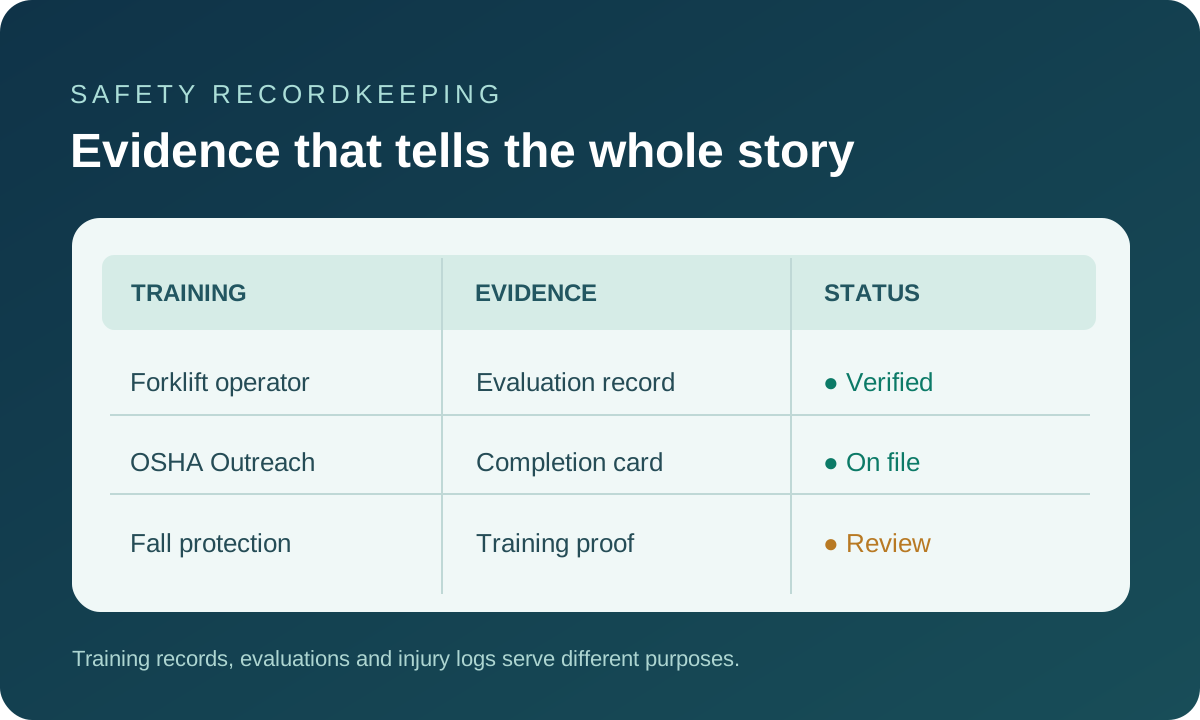
What to remember
- Different OSHA standards impose different training, certification, retraining and documentation requirements.
- An OSHA 10 Outreach card is not a substitute for hazard-specific training required by a standard.
- OSHA injury and illness logs are separate from employee training records.
- Track the applicable standard and actual evidence rather than applying one retention period to every course.
Start with the applicable standard—not a generic template
Training obligations depend on what hazards workers face. Construction safety instruction under 29 CFR 1926.21, powered industrial truck training under 29 CFR 1910.178, fall hazard training under 29 CFR 1926.503 and other rules have different details. Begin by identifying the specific standard for each job, role or activity.
Do not advertise a universal 'OSHA training records must be kept for X years' rule. Some standards specify detailed record content; others primarily describe required instruction. Separate legal retention duties from your company policy for keeping historical evidence.
Examples: different training rules, different evidence
| Topic | What the rule focuses on | Tracking approach |
|---|---|---|
| Powered industrial trucks | Training, operator evaluation and employer certification | Names, training and evaluation dates, trainers/evaluators |
| Construction safety instruction | Recognizing and avoiding hazards relevant to the job | Record instruction content and attendance as practical evidence |
| Construction fall hazards | Training certification, competency and retraining triggers | Follow the specific 1926.503 requirements |
| OSHA Outreach 10/30 | Voluntary awareness course completion | Keep card and completion date separate from standards training |
What fields should an employer's training register include?
A usable training record usually captures:
- Employee name and role or job assignment
- Training subject and applicable rule or policy
- Completion date, duration and training method
- Trainer or evaluator identity
- Evidence file or verified course completion record
- Equipment type, work location or hazard covered where relevant
- Evaluation date and outcome if a standard requires it
- Next review or re-training due date only when grounded in a rule or policy
- Supervisor accountable for resolving missing evidence
Consider a controlled naming system so 'Forklift', 'PIT', and 'Warehouse truck' do not create duplicate, incompatible training records. A credential management tool can help you store dates and proof consistently, but it cannot determine which legal obligations apply to a particular worksite.
Training records are not OSHA 300 logs
OSHA Forms 300, 300A and 301 deal with recording work-related injuries and illnesses. They are not a substitute for records showing who has received hazard-specific training. Conversely, a training register does not satisfy injury-and-illness reporting duties. Keep these workflows separate.
The same distinction applies to licenses and certifications: an employee may have an external course completion card while needing a separate, current employer evaluation. Your records should allow both to be retrieved without implying they are interchangeable.
How long should you keep training records?
Check each applicable OSHA regulation and any stricter state-plan or industry requirement. The federal rules do not set one blanket retention period for all safety training. For instance, different standards use different proof and retention frameworks, and some employer records may be needed for reasons beyond the minimum regulatory language.
A defensible internal policy identifies the legal minimum where specified, contract and insurance needs, employee lifecycle considerations, privacy obligations, and a written disposal schedule. Consult your safety/legal adviser for record types with complex retention or exposure history.
A simple monthly safety recordkeeping workflow
- 1Map roles to training requirements
List tasks and equipment by role, then link each one to the relevant standard or company procedure.
- 2Collect proof at hire
Record prior course completions, verify as appropriate and identify any required onsite evaluation or orientation.
- 3Check new or changed work
Update training requirements when an employee changes role, equipment or location.
- 4Review expiring and missing evidence
Run a monthly register review and weekly attention check for assignments with immediate exposure.
- 5Retrieve and inspect
Test whether a supervisor can pull the last training and evaluation proof for a named employee without hunting through email.
Questions to answer during review
- Can we show who trained and evaluated this employee?
- Does the evidence cover the assignment and actual equipment?
- Is the refresh due date grounded in a real requirement?
- Are outdated records marked as historical, rather than deleted without policy?
How to design an audit-ready filing structure
Keep one consistent employee record with clear evidence attachments, role requirements and review dates. For each standard, document what proof the employer expects and how it is verified. During internal audits, select a sample of active workers from a shift roster and confirm their role-based requirements and evidence, instead of inspecting only a random folder of uploaded certificates.
Use the employee credential lifecycle guide as the workflow foundation and the training records vs. certification records guide for a clearer division between learning completion and qualification proof.
Sources & references
These links support factual claims on this page. Requirements can vary by jurisdiction, role, and employer policy — verify obligations with the relevant authority when you need a formal determination.
- OSHA Training — employer training responsibilities — Overview of standards-based safety training
- 29 CFR 1910.178 — PIT training and evaluation records — Specific employer certification data for forklift operators
- 29 CFR 1926.21 — Construction safety training — Construction employers' instruction duties
- 29 CFR 1926.503 — Fall hazard training requirements — Example of standard-specific training certification
- OSHA Outreach Training Program FAQs — Outreach does not substitute for standards-specific training
Frequently asked questions
Does OSHA require a training log for every employee?
OSHA requirements depend on the specific standard and hazards. Some have express training certification or documentation rules; do not assume one universal OSHA log format.
How long must OSHA training records be kept?
There is no blanket federal retention period for all types of safety training records. Check each applicable standard and relevant state, contract or company policy.
Is an OSHA 10 card proof of all mandatory safety training?
No. Outreach course completion is safety awareness training and does not replace job-specific training required by applicable OSHA standards.
Are OSHA 300 logs training records?
No. OSHA 300/300A/301 concern work-related injury and illness recordkeeping, not proof that workers completed required safety training.
Keep exploring
Keep a dependable record of your team's qualifications
ComplyNestly organizes employee credentials, role requirements and the proof behind them. Your team remains responsible for interpreting legal obligations and verifying training.